

Easily charge your e-bike on the go
Always full bike batteries even without shore power
More and more campers are taking their e-bikes with them on camping holidays. To ensure that your cycling fun doesn't come to an abrupt end, this article tells you how to charge your e-bike while you're on the road.
Table of contents
Charging batteries via shore power
If you are staying at a campsite and have connected your motorhome to shore power, you can charge your pedelec battery very easily. You simply plug the charger into the motorhome socket and within a few hours the battery will be fully charged – just like at home. At almost all campsites, the mains voltage is now 230 volts, and even weakly fused campsite power supplies can easily handle charging the battery.
Here you can find out how the power supply works at the campsite.
Charging batteries without shore power
But you can also charge your e-bike battery without shore power. Read on to find out how.
Charging batteries via the on-board battery
If you want to charge the e-bike battery via the on-board battery while the motorhome is not connected to shore power, you need an inverter. This converts the motorhome’s 12-volt direct current into the 230-volt alternating current required by the charger.
Please note: The inverter should provide a pure sine wave output and not a modified sine wave.
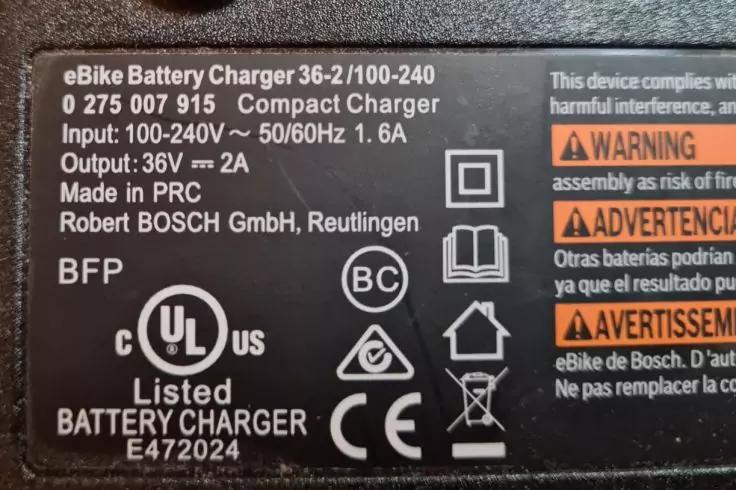
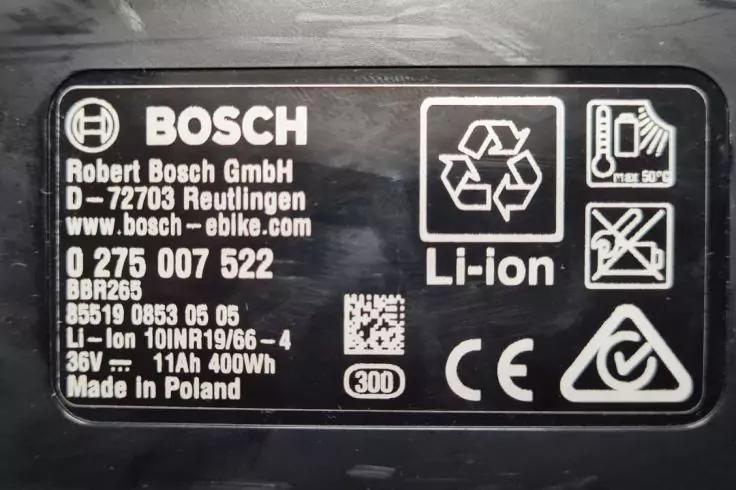
Depending on the manufacturer, e-bike batteries have capacities between 300 and 1250 Wh. You can find more detailed information on the battery itself or in the operating instructions. According to the manufacturer, the Bosch PowerPack 400 (meaning 400 watts) charges to 50 percent within 2.5 hours using the Compact Charger. After 6.5 hours it is charged to 100 percent — provided it is connected to a 230 V power source.
The charging time mainly depends on the charging current (measured in amperes) supplied by the charger. The formula is as follows:
| Nominal battery capacity in Ah | : | Charging current in A | * | 1.3 | = | Charging time |
| 11 Ah | : | 2 A | * | 1.3 | = | 7 hours |
Example: Bosch PowerPack 400 with Bosch Compact Charger.
With regard to the on-board battery, the important question is whether it can actually supply the required power. The key factor here is the battery capacity:
| Capacity of the e-bike battery in Wh | : | 12 V | + | 15 % loss | = | Battery capacity |
| 400 Wh | : | 12 V | + | 15 % loss | = | 38.3 Ah |
And now we need to know how much power the inverter must provide in order to charge the e-bike battery.
| Charging power of the battery charger in A | * | Voltage of the e-bike battery in V | + | 15 % loss | = | Power of the inverter in W |
| 2 A | * | 36 V | + | 15 % loss | = | 83 watts |
This means: charging a battery with a capacity of 400 Wh once takes around 7 hours if the charger provides 2 amps. There are also chargers with 4 A or 6 A, which can reduce the charging time accordingly.
So, to fully charge a battery at the motorhome at all, you need an inverter with at least 83 watts of power and an on-board battery with a capacity of at least 38 Ah.
Caution: A standard AGM or gel battery always retains some residual charge that cannot be used.
These calculations are only theoretical examples. In reality, these values are only approximate, because both the charger and the inverter draw power from the leisure battery. That is why a 15% loss is included here. In addition, there are normally other consumers in the motorhome, such as the refrigerator or a few lights, that also draw power.
Charging batteries with solar power
With a solar system, you can charge the on-board battery of your motorhome. This can then, as described above, charge your e-bike batteries even without a shore power connection. If you position your solar system, which has an output of 100 Wp, perfectly in the sun, it will produce 100 W, or 100 Wh, within one hour. As a general rule, a solar system can produce around four times its rated Wp output per day. So a 100 Wp solar system will generate roughly 400 Wh in one day if it is well aligned in the sun. Especially in summer, it therefore supplies enough energy to charge the leisure battery. This means you could fully charge the battery from the example above once. Here you can find out more about solar systems on camping holidays.
Tip: If you want to run your on-board battery on solar power, you should only charge your e-bike batteries when the sun is shining and not overnight.
Charging batteries with a 12 V charger
There are chargers for e-bike batteries that run on 12 volts. A 12 V charger is ideal as a travel charger for use in a motorhome or car, because no power-hungry inverter is required — it can simply be powered via the camper’s 12 V on-board electrical system. You can then use the power from your on-board battery for charging by plugging the charger into the cigarette lighter, for example. Naturally, the output of a 12-volt charger is lower than that of a 230 V charger, so the charging time is longer.
Charging batteries at e-bike charging stations
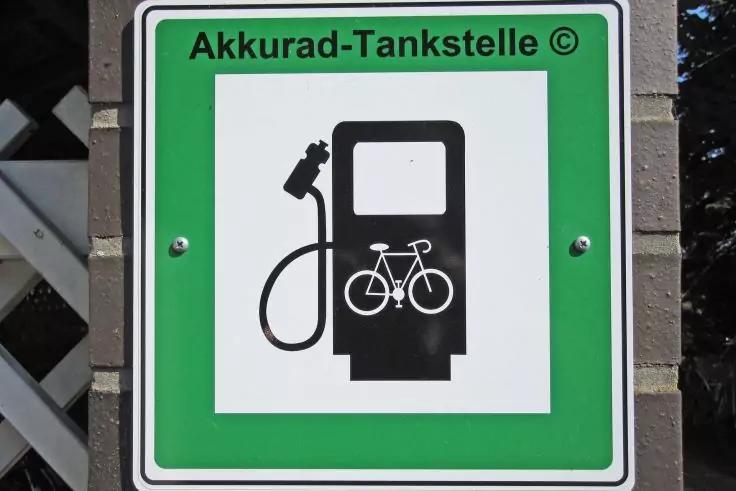
As e-bikes continue to grow in popularity, there is now a well-developed network of e-bike charging stations. Some campsites also offer e-bike charging points. At many of these stations, you can also borrow charging cables, so you do not always have to bring your own.
Here you can find an overview map with charging stations from the provider bike energy.
Tips for charging e-bikes
- It is possible to charge the battery while the motorhome is driving. Most alternators deliver enough power to charge both the leisure battery and the e-bike battery.
- When charging your battery without a shore power connection, keep an eye on the motorhome battery. This is the only way to see how much residual capacity is left and avoid deep discharge.
- Partial charging of modern Li-ion batteries reduces their service life. Depending on the manufacturer, the ideal battery charge level is between 50 and 100 percent. You can find this value in the operating instructions.
Conclusion: Always ready
If you often camp off-grid and do not have the option of connecting your motorhome to shore power, it may be necessary to charge your e-bike via the on-board battery. With these tips, you can now use your e-bike for longer and explore the surrounding holiday area. Have a good trip!