
Rear or Drawbar Bike Rack: Which Option Is Better?
The advantages and disadvantages of the mounting positions on the caravan
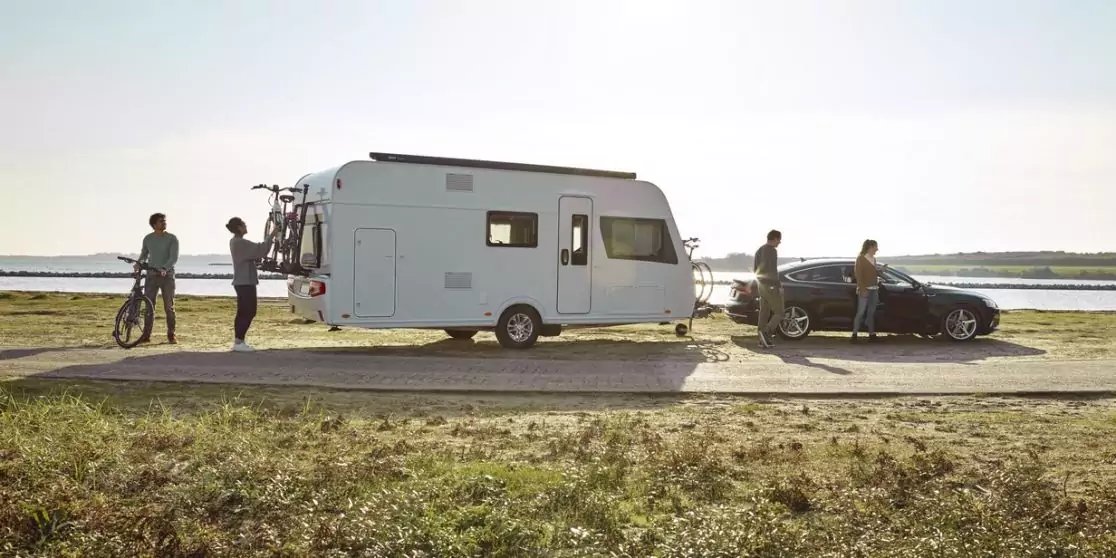
There are various options for transporting bicycles on the caravan. In this guide, we explain the differences between drawbar and rear carriers and tell you what you need to consider when installing and using the bicycle carrier.
Table of contents
These types of bicycle carriers are available
The market for bicycle carriers has grown steadily in recent years, so today there are numerous providers and models. Whether you have a large or small budget: there is a suitable bicycle carrier for every requirement.
In principle, bicycle carriers for caravans differ in their mounting positions. There are carrier systems for rear mounting directly on the caravan or for installation on the caravan drawbar. E-bike carriers can be identified by their higher load capacity and are often equipped with a lift to make loading heavy electric bikes easier.
Important regulations
Note: not all systems are suitable for every caravan! Before buying, you should check whether your caravan model is compatible with the desired bicycle carrier. Especially for caravans with particularly short drawbars, attaching a drawbar carrier can cause problems. You can find out whether the carrier fits your caravan from a specialist dealer or the manufacturer.
In principle, bicycle carriers and the bicycles on them are considered (additional) load or vehicle attachments and are therefore subject to road traffic regulations (see §22 StVO).
When mounting the carrier and transporting the bicycles, you must comply with permitted size limits as well as securing and marking requirements.
If the bicycle carrier covers the vehicle’s number plate, an additional number plate must be attached to the carrier.
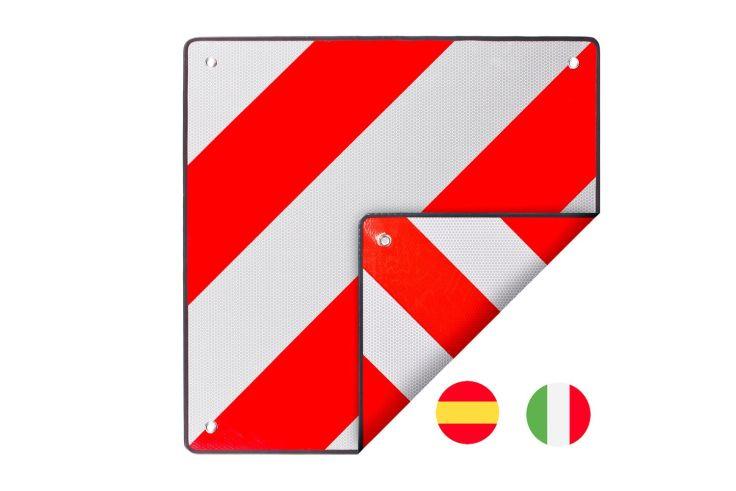
When travelling to Italy and Spain, a red and white striped warning sign must also be attached to the bicycle carrier. Note that you cannot use the same warning sign in both countries, as national regulations differ in stripe layout and width.
The rear bicycle carrier
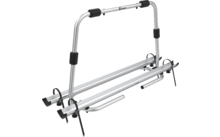
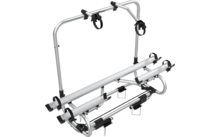
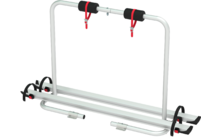
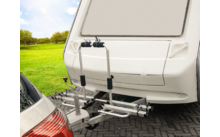
Rear bicycle carriers are permanently bolted to the rear wall of the caravan. When loading, you must ensure that the permissible load capacity is not exceeded, otherwise there is an increased accident risk for following vehicles.
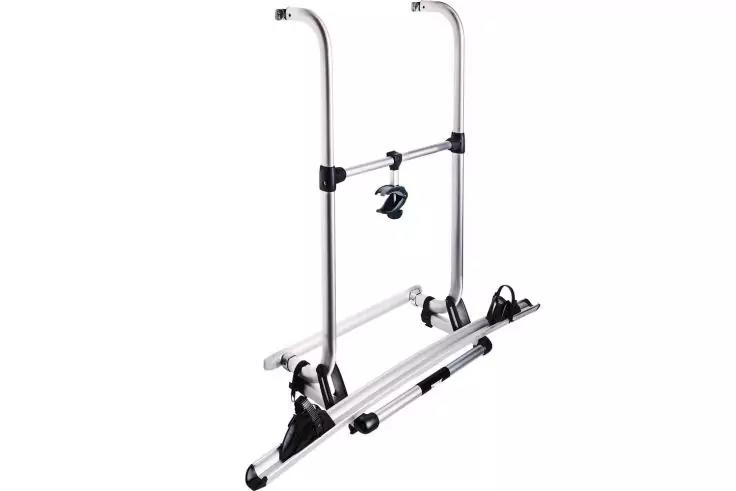
Rear carriers offer the advantage that bicycles can be transported space-saving at the rear of the caravan. However, the elevated position makes loading and unloading more difficult. Special models for e-bikes are also available with lifting systems.
The additional weight increases the rear load of the vehicle and reduces the load on the coupling. This so-called nose weight is important for safe driving.
In addition, negative driving characteristics (e.g. sensitivity to crosswinds, swaying or snaking) can be intensified by rear carriers.
Installing a rear bicycle carrier
Safe installation requires precise knowledge of the caravan rear wall structure and mounting points. Interior fittings may obstruct installation, and drill holes must be sealed properly to prevent moisture ingress.
It is therefore recommended to have installation carried out by a specialist workshop. Improper installation can lead to serious consequences, including damage to your caravan or accidents involving other road users.
The carrier is mounted via a rail fixed and glued to the rear wall. The base is attached at the top and bottom, and the wheel rails can usually be adjusted in height.
Advantages and disadvantages
often cheaper than drawbar carriers
affects driving stability
increases overall vehicle length
loading/unloading is more strenuous
Find suitable rear bicycle carriers in our shop




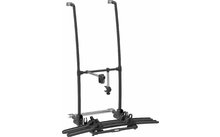
The drawbar bicycle carrier
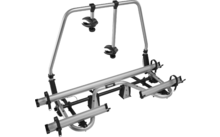
Drawbar bicycle carriers are mounted between the drawbar box and the jockey wheel. Ensure access to the drawbar box, handbrake and jockey wheel remains unobstructed.
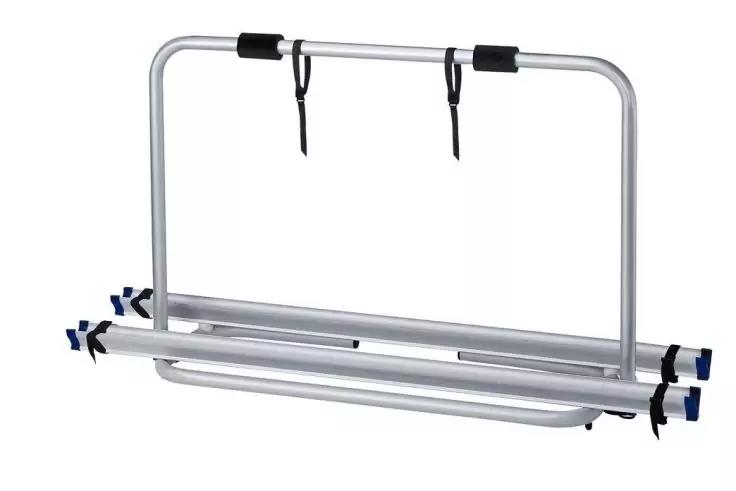
Some models feature a tilting or folding mechanism, allowing access to the drawbar box even when loaded.
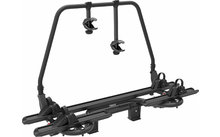
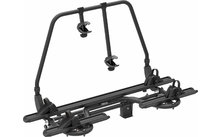
Another solution is the Eufab BS260 drawbar carrier, which uses a sliding rail system for easy handling.
Transporting bikes on the drawbar offers many advantages. The low mounting height makes loading easier, and the forward position improves driving stability. You can also keep an eye on your bikes while driving.
However, the nose weight increases. Caravan drawbars are usually limited to around 100 kg, and this must not be exceeded.
The position of the drawbar carrier can affect the turning angle of the towing vehicle. In tight turns or manoeuvres, there is a risk of collision with the vehicle.
Installing a drawbar carrier
Installation is generally simpler and usually done by clamping the carrier to the drawbar frame. No drilling is required.
However, due to liability risks, professional installation is still recommended.
A specialist workshop ensures proper installation and assumes liability in case of faults.
Advantages and disadvantages
easy loading thanks to low height
risk of exceeding nose weight
minimal impact on driving stability
usually more expensive
access to drawbar box (on premium models)