
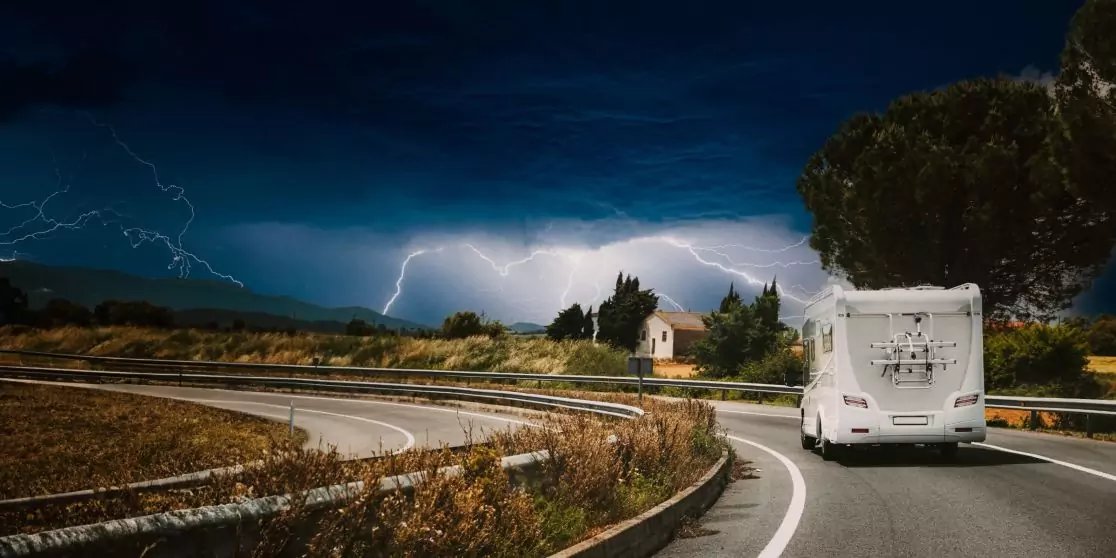
Camping during thunderstorms: You need to know!
How to protect yourself in a caravan, motorhome or tent from lightning strikes
There is crashing, lightning and thunder, the rain splashes on the roof: This is probably not how you imagined your camping trip. So that you are well prepared if you are surprised by a storm while camping, I have some valuable tips for you here.
Table of contents
A few facts beforehand: Thunderstorm statistics
Worldwide, 10 to 30 million lightning bolts are observed in one day, but only 10 percent of all lightning bolts actually strike the ground. (Source: Wikipedia)
On average, about 700 people are struck by lightning each year, but with quick medical help, almost all survive. Nevertheless, about 75 percent of lightning victims suffer long-term damage. (Source: RP Online)
Every year, between three and seven people die in Germany as a result of lightning strikes.
How dangerous is a thunderstorm when camping?
A thunderstorm can always be dangerous for you outdoors, whether you are hiking or camping. Lightning always strikes at particularly exposed points, i.e. at the highest points. You are only safe from lightning strikes in buildings or in vehicles with metal construction. A thunderstorm when camping in a caravan, motorhome without a metal frame or tent is therefore a serious threat.
A thunderstorm is often also associated with heavy rain, hail or strong winds. You should also think about the dangers involved: Flying objects, falling branches or falling trees.
These are the dangers of a lightning strike
Direct impact: In this case, the lightning strikes directly into the highest point on a surface. For example, into the tent frame or into a person sitting in a tent in a meadow.
Flashover: In this variant, lightning can jump from a tree to people over several metres. Such a flashover can occur at a distance of up to three metres.
Step voltage: The current from the lightning strike spreads over the ground. If you then walk (legs not together), part of this current surge can shoot up one leg, flow through your body and exit again through the other leg.
Contact voltage: If you touch an object that is struck by lightning (e.g. tent frame, metallic objects in a caravan or motorhome…), the lightning current can flow through you. This also applies if you are standing in water.
It is important that you are aware of this risk, because only then can you protect yourself against it!
How to avoid danger during a thunderstorm at the campsite
- Do not camp on elevated ground.
- Do not spend the night near isolated trees.
- Also avoid pitches near high masts.
- Do not stretch metal clotheslines between your tent and camping vehicles.
- During a thunderstorm, it is best to stay in a vehicle with a metallic outer shell or in a building.
- Disconnect all power connections to your tent, caravan or camper van.
- Remove all external antennas.
Vehicles with a metallic outer skin act like a Faraday cage: The metallic outer skin conducts the lightning current and inside the „cage“ you are protected.
Protection against thunderstorms when camping
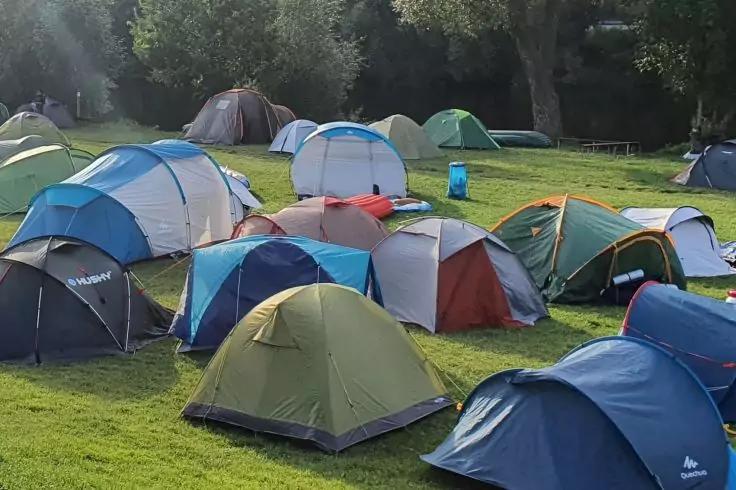
Tents offer you no protection against lightning strikes, so choosing the right pitch is an important criterion for your safety. Keep the previous points in mind and do not pitch your tent in hollows or dry riverbeds. They can turn into raging torrents during a thunderstorm. In addition, water can conduct lightning. In strong winds, you should secure your tent beforehand with guy ropes. In this blog post, we show you how to properly tension your tent and make it stormproof
If you are nevertheless surprised by a thunderstorm in your tent, stay calm. Sit in the tent on a dry, insulating surface and keep your legs and feet together to avoid the risk of step voltage. Do not lie down!
As a general rule: Make sure that your tent is not the highest point in a larger open area.
During thunderstorms in the caravan
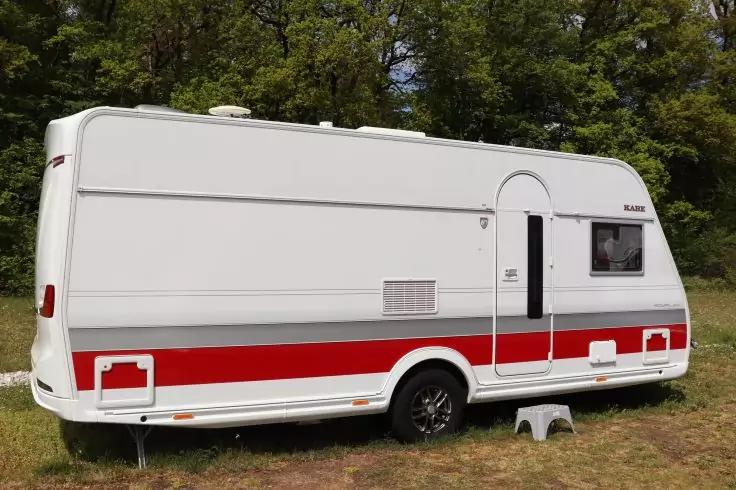
In a caravan with a GRP outer skin, i.e. a non-metallic frame, you are not protected against lightning strikes. If lightning strikes a caravan with a GRP body, it will seek the shortest path to the ground and may hit gas lines, electrical wiring or even people.
Only in the case of a caravan with a metallic outer shell or outer panelling made of at least 0.5 mm thick aluminium is protection against lightning strikes provided. This is on the condition that the metal parts are conductively connected to each other. In the case of a metallic vehicle frame, the lightning strikes and ideally exits again via the corner steadies or the wheels. In this case, there is no danger to the occupants.
If your caravan consists of a combination of an aluminium outer wall and a GRP roof, you are not protected inside it because it is not metallic all around and therefore does not form a Faraday cage.
If possible, you should retreat to your car during a thunderstorm or, even better, go into a building.
During thunderstorms in the motorhome
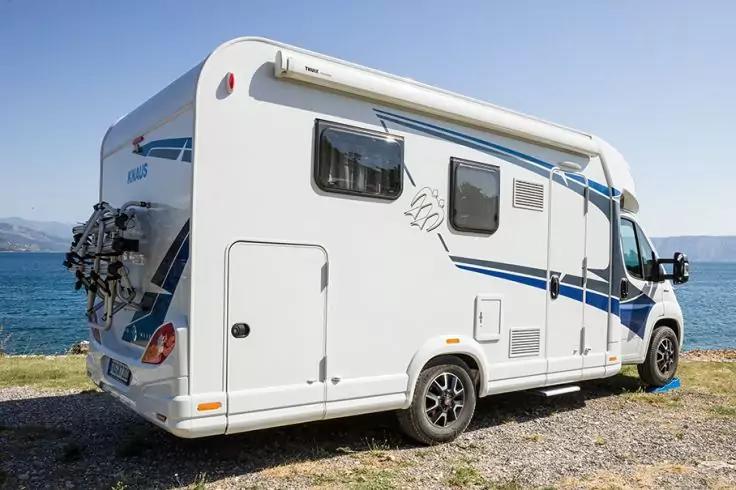
As with a caravan, you are only protected in a motorhome if the vehicle has a metallic body. Camping buses and panel vans in particular are often built according to this principle. The lightning current then flows via the outer shell into the ground.
What should I do if I am outdoors during a thunderstorm?
You should immediately seek shelter in a car or building if possible. If no protection is available, look for lower-lying ground in an open field. Stay there in a crouched position with your legs together until the thunderstorm has passed. You should absolutely avoid trees.
Generally important behaviour during thunderstorms in recreational vehicles
- Do not lie down in alcoves or pop-top roofs during a thunderstorm. There is usually no metal frame there to dissipate the lightning current.
- Do not use the shower or tap during the thunderstorm.
- Disconnect all 230 V cables.
- Do not touch any metallic components of the motorhome or caravan.
- Do not stick your head out of roof hatches or windows.
- Keep windows, doors, pop-top roofs and folding roofs closed.
- Retract the awning.
- Retract antennas or remove them.
- In camper vans and semi-integrated motorhomes, the safest place is in the driver's cab. If possible, caravan users should sit in their car.
- Do not stay in the awning.
After the thunderstorm, be sure to check the tyres. Lightning strikes can cause the steel belt to corrode.
Where is the thunderstorm?
As soon as you hear the first thunder, you should seek shelter while camping. The thunderstorm is then less than ten kilometres away. After a flash of lightning, count the seconds until the thunder. Divide the number by three and you will get the approximate distance of the thunderstorm in kilometres. The first lightning strike means danger.
Only if you have not heard thunder for at least 30 minutes is the thunderstorm over.
Further links
Here you can find further information on lightning protection when camping.
A 12-page VDE brochure on lightning protection when camping is available here.
Conclusion: Do not take thunderstorms lightly
Even though the likelihood of being struck by lightning is very low, severe weather is often underestimated and most campers are unaware of the dangers of a lightning strike in a recreational vehicle or tent. So get to safety in good time and stay calm. I was not aware of the danger in a caravan either and will follow this advice in future.
